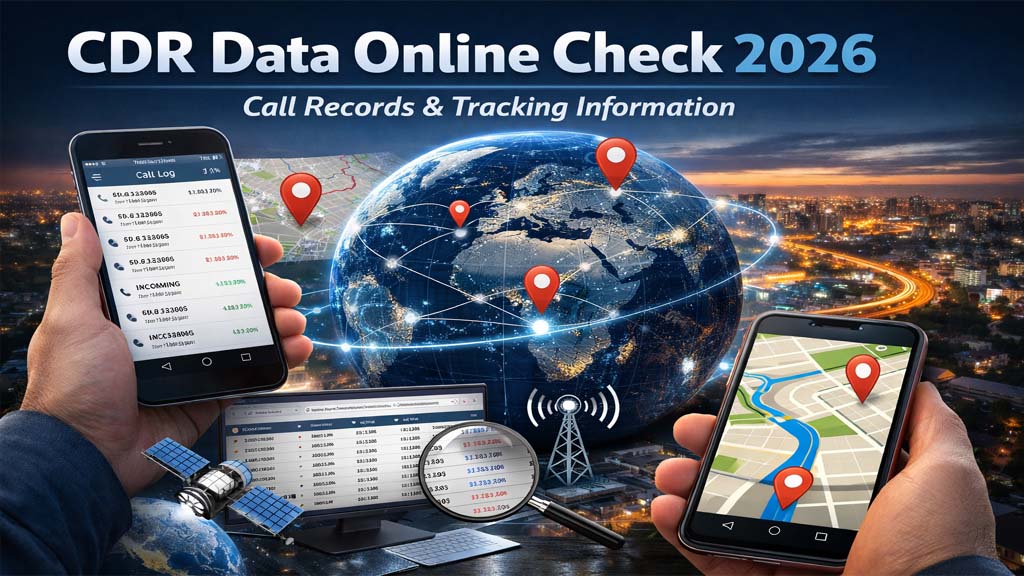
CDR Data Online Check 2026: Call Records & Tracking Information
In the rapidly evolving digital landscape of 2026, information is power. Whether you are a legal professional, a private investigator, or an individual trying to verify the security of your own communication lines, understanding CDR (Call Detail Record) data is crucial.
As cybersecurity threats and sophisticated scams become more prevalent, the demand for “CDR Data Online Check” services has skyrocketed. But what exactly is CDR data? How can one access it legally in 2026? And what are the ethical boundaries involved? This massive guide covers everything from the basics of call logs to advanced digital forensics.
What is CDR Data? Understanding the Basics
A Call Detail Record (CDR) is a data record produced by a telephone exchange or other telecommunications equipment that documents the details of a telephone call or other telecommunications transaction (like SMS or internet usage) that passes through that facility.
Key Components of a CDR:
| Field Name | Data Type | Description | Example Entry |
| Record ID | UUID | Unique identifier for the specific transaction. | 550e8400-e29b-41d4 |
| Calling Number | MSISDN | The phone number initiating the call/SMS. | +923001234567 |
| Called Number | MSISDN | The phone number receiving the call/SMS. | +923219876543 |
| Start Time | Timestamp | Date and exact time the connection began. | 2026-03-14 12:05:01 |
| End Time | Timestamp | Date and exact time the connection terminated. | 2026-03-14 12:10:45 |
| Duration | Seconds | Total active time of the communication. | 344 |
| Call Type | Category | Voice, SMS, Data, or VoNR (5G/6G Voice). | Voice (VoNR) |
| IMEI | Numeric | The unique serial number of the physical device. | 358901012345678 |
| IMSI | Numeric | Unique ID linked to the SIM card profile. | 410010123456789 |
| Cell Tower ID | Hex/Dec | The ID of the tower the phone was connected to. | LAC: 405, CID: 21 |
| Location (Lat/Long) | GPS | Approximate coordinates based on tower triangulations. | 31.5204° N, 74.3587° E |
| Termination Cause | Code | Reason the call ended (Normal, Dropped, Busy). | Normal Release (16) |
| Data Usage | MB/GB | Volume of data transferred (if a data session). | 45.2 MB |
In 2026, CDRs have become even more complex. With the integration of 6G-ready networks and VoNR (Voice over New Radio), CDRs now include metadata regarding data packets, latency, and even satellite handoff information for global roaming.
The Evolution of CDR in 2026: What’s New?
Back in 2020, CDRs were relatively simple text files. By 2026, the architecture of telecommunications has shifted toward AI-driven analytics.
AI Integration
Telecom providers now use AI to categorize CDR data in real-time. This helps in detecting “Sim Swap” frauds and “Spoofing” attempts. If you are performing a CDR data online check, you are likely interacting with an AI-filtered interface that highlights anomalies.
Satellite and Hyper-Localization
With the expansion of Starlink and other LEO (Low Earth Orbit) satellite constellations, CDR data now includes “Z-axis” coordinates meaning height/altitude is often recorded alongside latitude and longitude. This makes tracking the origin of a call more precise than ever before.
Why Do People Need CDR Data Online Checks?
There are several legitimate and security-focused reasons why individuals and organizations seek CDR data:
Personal Security and Fraud Prevention
If you receive harassing calls or suspect your identity is being used to commit crimes, checking your CDR data is the first step. By visiting resources like https://simownerxyz.com/, users often look for ways to verify the ownership and history of a SIM card associated with specific call logs.
Corporate Auditing
Businesses use CDR analysis to ensure that company-provided mobile devices are being used for professional purposes. It also helps in cost-cutting by identifying unused lines or excessive data roaming charges.
Legal and Forensic Evidence
In 2026, digital evidence is the cornerstone of the judicial system. CDRs provide an “unalterable” timeline of events. Law enforcement agencies use these records to place suspects at a crime scene or to corroborate witness statements.
How to Check CDR Data Online (Step-by-Step)
Checking CDR data is not as simple as a Google search; it requires following specific protocols to ensure the data is accurate and legally obtained.
Step 1: Requesting Records from the Provider
The most legal way to access CDR data is through the Network Service Provider (NSP). In 2026, most providers have a “Privacy Portal” where subscribers can download their own logs after undergoing multi-factor biometric authentication.
Step 2: Using Third-Party Verification Tools
Sometimes, you need to verify the owner of a number before diving into the CDR. This is where platforms like simownerxyz.com come into play. These tools help users identify the registration details of a SIM card, which is the first piece of the puzzle in any CDR investigation.
Step 3: Importing Data into Analysis Software
Once you have the raw CSV or XML file from the provider, you use software like IBM i2 Analyst’s Notebook or specialized CDR Analyzers to visualize the links between different phone numbers.
Legal Framework and Privacy Laws in 2026
Privacy laws have tightened significantly. The Global Data Privacy Regulation (GDPR) 2.0 and the Digital Communications Act of 2025 dictate who can see CDR data.
- Consent: You cannot legally check the CDR of another adult without their explicit consent or a court order.
- Data Retention: In most jurisdictions, telecom companies are required to store CDR data for a minimum of 2 years and a maximum of 5 years.
- Encryption: In 2026, CDR files are end-to-end encrypted. Accessing them through “leaked” databases is not only illegal but often leads to malware infections.
The Role of SIM Information in CDR Analysis
You cannot understand a CDR without understanding the SIM card. Every CDR is tied to an IMSI (International Mobile Subscriber Identity).
If you are looking for SIM owner details or want to track the history of a specific mobile number, utilizing a SIM Information System is essential. These systems allow you to cross-reference the CDR’s “Cell Site ID” with the “Subscriber Name,” helping you identify exactly who was holding the device at a specific time.
Why SIM details matter:
- Identity Verification: Ensures the person claiming to own the number is the actual registrant.
- Location Context: Cross-referencing the address on the SIM registration with the towers hit in the CDR.
- Network History: Seeing if the SIM has been ported between different networks.
Common Tools and Software for CDR Analysis
As we move through 2026, the tools have become more “cloud-native.”
- CDR Live: A real-time monitoring tool used by law enforcement.
- SimOwnerXYZ Tools: Excellent for quick lookup of SIM registration data and owner names.
- XRY/Cellebrite: Used for extracting CDR-like data directly from the hardware of a mobile device.
- Google Earth Pro: Used for plotting the Cell Site IDs from a CDR onto a 3D map to visualize movement patterns.
FAQs:
Can I check someone’s CDR online for free?
While some websites claim to offer this, most are scams. Legitimate CDR data is protected by privacy laws. However, you can check SIM owner details and basic registration info through verified portals like simownerxyz.com.
How long do mobile companies keep call records in 2026?
Most major carriers keep CDRs for 2 to 5 years depending on the country’s local regulations (e.g., Data Retention Directive).
Is it possible to delete my CDR from the company server?
No. Telecom companies are legally mandated to keep these records for national security and tax purposes. You can request a copy of your data, but you cannot delete the master record.
Does CDR include WhatsApp or Telegram calls?
No. Standard CDRs only record “Circuit Switched” calls (traditional mobile calls) and SMS. WhatsApp and Telegram use “Packet Switched” data. The CDR will show that you used “Data/Internet,” but it won’t show who you called inside an encrypted app.
How can I find the location of a caller using CDR?
By looking at the Cell Tower ID in the CDR, you can find the coordinates of the tower the phone connected to. This gives a radius of where the person was located during the call.
Conclusion:
The year 2026 marks a turning point in how we handle communication data. The CDR Data Online Check is no longer just a tool for the police; it is a vital part of personal digital hygiene. Knowing who is calling you, verifying SIM ownership via https://simownerxyz.com/, and understanding the trail your own phone leaves behind is essential for navigating the modern world.